
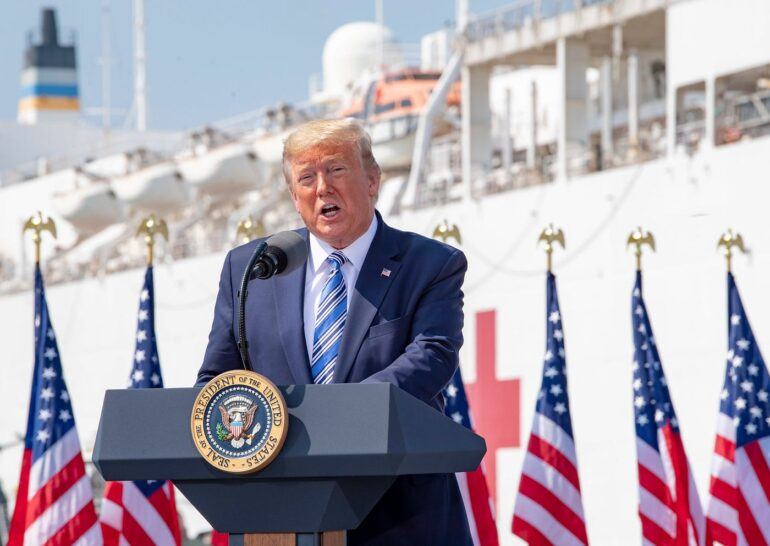
President Trump’s Monday morning threat to impose tariffs on eight European countries that oppose his ambition to annex Greenland escalated already severe transatlantic tensions into potential economic warfare between NATO allies, demonstrating how the administration’s aggressive foreign policy has created simultaneous crises across multiple theaters while domestic military deployments reach levels unprecedented in modern peacetime America. The Pentagon’s preparation of 1,500 soldiers for possible deployment to Minnesota to confront protesters demonstrates Trump’s willingness to use military force against American citizens on a scale that transforms the Insurrection Act from theoretical executive power into practical tool of domestic political control, creating conditions where politics increasingly resembles authoritarian governance rather than democratic administration operating under constitutional constraints.
Denmark and Greenland diplomats traveled to the White House on January 16 to meet with Vice President JD Vance after Trump repeated threats to take over the autonomous Danish territory, a diplomatic crisis with a NATO ally that raises fundamental questions about the administration’s respect for international law and territorial sovereignty. European Union President of the European Council António Costa and President of the European Commission Ursula von der Leyen’s scheduled visit to India for the 77th Republic Day celebrations on January 26 provides convenient escape from escalating tensions with Washington, though the timing appears deliberate as EU leadership positions itself to deepen strategic partnerships with democracies beyond the increasingly unstable Atlantic alliance.
Three top Catholic cardinals in the United States issued an unusual statement Monday denouncing U.S. foreign policy, saying the country’s “moral role in confronting evil around the world” was in question. The cardinals cited the U.S. attack on Venezuela, Trump’s threats against Greenland, and Russia’s war in Ukraine, writing that “In 2026, the United States has entered into the most profound and searing debate about the moral foundation for America’s actions in the world since the end of the Cold War.” The religious condemnation from senior Catholic leadership represents extraordinary break from the institutional church’s typical reluctance to criticize sitting administrations and signals that Trump’s foreign adventurism has alienated traditional conservative constituencies who might otherwise support Republican governance.
An Episcopal bishop in New Hampshire urged fellow clergy Monday to finalize their wills and prepare for what he called a “new era of martyrdom,” making comments during a vigil honoring Renee Good, the American mother shot dead by ICE agents in Minneapolis. Bishop Rob Hirschfeld’s characterization of current conditions as potentially requiring clergy to sacrifice their lives defending congregants and vulnerable populations demonstrates how religious leaders view the administration’s immigration enforcement and willingness to deploy violence against citizens. The bishop’s call for death preparations represents rhetorical escalation that transforms what might be dismissed as progressive hyperbole into serious institutional assessment by mainline Protestant denomination leadership.
The Department of Justice announced investigations into Minnesota Governor Tim Walz and Minneapolis Mayor Jacob Frey focusing on possible obstruction of federal law enforcement, accusations both men vehemently denied while characterizing the probes as political retaliation for criticizing the Trump administration’s immigration enforcement tactics. Walz’s Friday announcement withdrawing from Minnesota’s next gubernatorial race, where he said “Every minute that I spend defending my own political interest would be a minute I can’t spend defending the people of Minnesota,” hands Trump significant victory by removing vocal critic from electoral politics while sending message to other governors and mayors that resistance carries severe personal cost.
A federal judge ruled Friday that ICE agents are not allowed to arrest peaceful protesters or stop people in their cars without cause, providing limited judicial pushback against the administration’s aggressive tactics but raising questions about enforcement when federal agents operate with apparent presidential backing to ignore court orders. The ruling came as protests continued in Minneapolis and spread to other cities, with demonstrators demanding accountability for Good’s killing and broader reforms to immigration enforcement that has resulted in at least 568 injured police officers according to administration figures by early January.
Trump openly called for regime change in Iran in an interview with Politico Monday, saying “It’s time to look for new leadership in Iran.” This comes as an internet blackout continues in Iran, where security forces have largely crushed nationwide protests that began December 28. The U.S.-based Human Rights Activists News Agency says it has verified deaths of over 3,900 protesters since protests began, though the group says the death toll could be far higher given government efforts to suppress information. At least 180 security forces have also been killed, with the Iranian government blaming some of the unrest on armed agitators rather than acknowledging legitimate grievances about economic collapse from systematic corruption that saw $8 billion in oil revenues disappear.
The Iranian regime successfully shut down Starlink internet for the first time amidst the ongoing blackout, demonstrating that even Elon Musk’s satellite network can be defeated by determined authoritarian governments willing to deploy sufficient technical resources. The shutdown represents significant technical achievement for Iranian authorities and demonstrates that commercial satellite internet doesn’t guarantee communications access when regimes possess sophisticated jamming capabilities and political will to deploy them regardless of cost.
Israeli forces began Monday demolishing the headquarters of UNRWA, the United Nations Relief and Works Agency, in occupied East Jerusalem. In a statement, the U.N. agency said “This is an unprecedented attack not only against UNRWA and its premises. It constitutes a serious violation of international law and the privileges and immunities of the United Nations.” UNRWA was formed in 1949 to provide aid to Palestinians displaced during the establishment of Israel, and its destruction represents escalation in Israeli government efforts to eliminate the agency and its institutional memory of Palestinian displacement.
Trump invited Putin, Xi Jinping, and Netanyahu to join a “Board of Peace” to oversee Gaza ceasefire implementation, a proposal that demonstrates the president’s preference for authoritarian strongmen over democratic allies and international institutions. The invitation of Chinese and Russian leaders to mediate Middle East peace represents departure from decades of U.S. policy limiting rival great powers’ influence in the region, potentially creating conditions where American hegemony fragments further as other nations expand their regional footprints.
Washington Post reported Monday that the Department of Justice is looking to weaken gun laws to appeal to Second Amendment supporters, with DOJ officials reportedly seeking to announce new rules at the National Shooting Sports Foundation gun trade show in Las Vegas. Deputy Attorney General Todd Blanche is scheduled to speak at the trade show, demonstrating how the administration prioritizes Second Amendment absolutism even as domestic political violence and military deployments against civilians escalate.
Coalition of activist groups called for a nationwide walkout Monday to protest Trump administration policies, though turnout appeared modest compared to massive demonstrations that followed the first Trump administration or 2020 racial justice protests. The relatively muted response suggests either protest fatigue, fear of government retaliation following Minnesota crackdown, or normalization of authoritarian governance where extraordinary presidential actions no longer shock enough Americans to generate mass resistance.
In sports news largely overshadowed by political chaos, Myanmar held the second phase of elections Monday to elect the nation’s bicameral legislature, with one more voting phase expected in late January. The elections proceed under military junta control following the 2021 coup that overthrew elected government, rendering them essentially meaningless democratic theater designed to provide thin legitimacy veneer to authoritarian rule. Citizens in Benin voted to elect 109 members of the National Assembly more than one month after a thwarted coup attempt, reflecting the fragile political situations facing many African democracies where military intervention remains constant threat.
Ugandan President Yoweri Museveni was reelected to a seventh term in elections widely condemned as neither free nor fair by international observers, extending his 40-year rule over Uganda that has seen the country transform from liberation movement led by relatively progressive revolutionaries into corrupt authoritarian state where political opposition faces systematic repression. The election results demonstrate how incumbent presidents in many African nations have perfected techniques for maintaining power through controlled electoral processes that provide democratic legitimacy veneer while ensuring outcomes remain predetermined.
At least 19 people were killed in Chile wildfires that ravaged areas around Valparaíso, with the death toll expected to rise as firefighters gained access to previously inaccessible areas devastated by flames. Climate change-driven extreme weather events continue creating humanitarian disasters across South America, with Chile’s Mediterranean climate becoming increasingly prone to severe droughts followed by intense wildfires that overwhelm firefighting capacity.
Guatemala declared a state of emergency Monday after 10 police officers were killed in attacks attributed to organized crime groups, demonstrating how narcotics trafficking and gang violence threaten governance capacity in Central American nations. The attacks represent escalation in confrontation between criminal organizations and government forces, with cartels apparently willing to directly target security forces rather than maintaining lower profiles that had characterized their operations in previous years.
Hundreds protested in Davos, Switzerland, ahead of Trump’s visit to the World Economic Forum, with demonstrators opposing the president’s climate policies, immigration enforcement, and authoritarian governance. The Davos protests received minimal media coverage compared to Minneapolis demonstrations, suggesting that international opposition to Trump administration policies matters less to American political dynamics than domestic resistance that directly threatens his ability to maintain control.
U.N. Human Rights Chief Volker Türk visited Sudan Monday to assess humanitarian conditions in the country ravaged by civil war between competing military factions, though prospects for meaningful intervention remain limited given international community’s focus on other crises and lack of political will to deploy peacekeeping forces or impose sanctions that might pressure warring parties toward negotiations. The Sudan conflict has created one of world’s worst humanitarian disasters with millions displaced and facing starvation, yet receives fraction of attention devoted to Ukraine or Gaza.
The convergence of multiple international crises, domestic political violence, religious condemnation of foreign policy, judicial pushback against immigration enforcement, and preparations for military deployment against American protesters creates an environment where normal governance has given way to rolling emergencies that the Trump administration appears to welcome rather than attempt to resolve. When the president simultaneously threatens tariffs against European allies over Greenland annexation demands, calls for regime change in Iran where 3,900 protesters have died, prepares to deploy 1,500 troops against Minnesota demonstrators, and invites authoritarian rivals Putin and Xi to join Middle East peace boards, it signals fundamental departure from American foreign and domestic policy traditions that structured international relations and constitutional governance since World War II.
The question facing Americans and international observers is whether these represent temporary disruptions from which norms and institutions will recover once Trump leaves office, or whether they constitute inflection point where democratic backsliding accelerates into authoritarian consolidation that proves irreversible. The willingness of Pentagon leadership to prepare domestic troop deployments, Justice Department prosecutors to investigate political opponents, and federal agents to kill American citizens without accountability suggests that institutional resistance to presidential overreach has eroded to point where guardrails that constrained previous administrations no longer function effectively.
Redpulse Pro is built for readers who want to go deeper into the stories that shape finance, politics, and power. While our free content keeps you informed, Pro gives you the tools, insights, and access to stay ahead of the curve. With our Pro subscription, you follow the money, uncover hidden connections, and get the inside track on the narratives mainstream media won’t touch. Subscribe to Redpulse Pro here.

