
If you’ve been watching politics and markets in separate windows on your screen, today is the day you need to close one of them — because the story of the week is the same story either way, and you’re missing the trade if you’re not seeing both simultaneously.
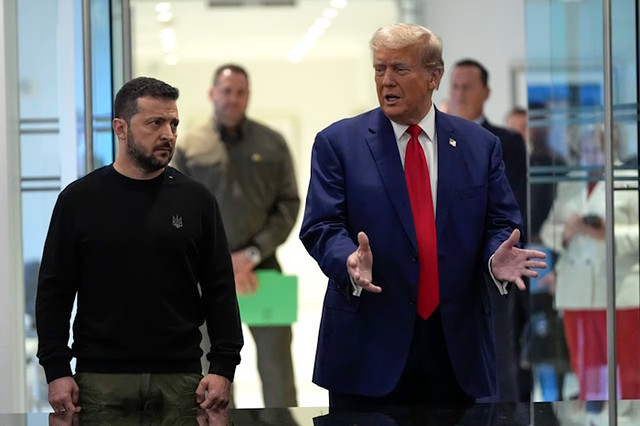
On Wednesday, February 19, President Trump escalated his very public war of words with Ukrainian President Volodymyr Zelensky, calling him a “dictator without elections” in a Truth Social post and warning that Zelensky “better move fast or he is not going to have a country left.” The remarks came just one day after U.S. and Russian officials held historic talks in Riyadh, Saudi Arabia — without Ukraine present — and they sent shockwaves through European markets overnight. More importantly for our purposes today, they are reshaping commodity and ETF positioning across energy, precious metals, and defense sectors in real time.
Here’s what you need to know — and more importantly, how to position yourself before the mainstream financial press catches up.
The Ukraine wildcard: why the peace trade is the most mispriced bet in markets right now
Trump’s public humiliation of Zelensky is not just a diplomatic spectacle. It is a deliberate negotiating strategy designed to pressure Ukraine into accepting a ceasefire on terms favorable to Russia and, by extension, favorable to Trump’s claim that he alone can end a war the establishment couldn’t. The question every ETF investor should be asking right now is: what happens to energy markets if this actually works?
The answer is straightforward, even if the timing isn’t. A credible Ukraine-Russia ceasefire removes roughly 3 to 5% of the geopolitical risk premium that has been baked into global commodity prices since February 2022. European natural gas prices — still elevated relative to pre-war levels — would face immediate downward pressure. U.S. LNG exporters like Cheniere Energy, which have profited enormously from Europe’s desperate hunt for non-Russian supply, could see margin compression. Meanwhile, Russian oil would begin flowing more freely through international markets, adding supply-side pressure on crude.
The net effect on commodity prices is complex. The deflationary shock from peace would push oil and gas lower in the near term — bearish for pure energy ETFs like XLE or XOP. But here’s the conspiracy angle mainstream financial media refuses to touch: the big-money institutions that have been positioned in defense ETFs since 2022 have a tremendous financial interest in keeping this war going as long as possible. Raytheon, Northrop Grumman, L3Harris — these are the companies that have printed money while Ukraine burned through Western weaponry. Watch the defense ETF (ITA) closely. A genuine ceasefire doesn’t just end a war — it ends a multi-billion-dollar revenue stream for some of the most politically connected companies on Earth.
Gold above $2,940: the real reason the “smart money” is piling in right now
Gold crossed $2,940 per ounce this week, just short of the $3,000 psychological barrier that would trigger a wave of retail FOMO-buying and momentum acceleration. Here’s what the talking heads won’t tell you: the reason gold is surging has very little to do with conventional inflation fears and almost everything to do with de-dollarization and geopolitical realignment.
The Bank of America February global fund manager survey — released this week — found that 50% of professional fund managers currently view buying gold as the most crowded trade in the world. That’s a remarkable statistic, but here’s the twist: in most markets, when a trade becomes “the most crowded,” it’s a contrarian sell signal. With gold, the opposite dynamic is playing out. The buyers aren’t momentum-chasing retail traders. They are central banks — particularly China, Poland, and emerging market sovereigns — who are buying gold as a structural replacement for U.S. Treasury holdings. These buyers are price-insensitive. They will buy at $2,500, at $3,000, and probably at $4,000. That changes the risk calculus for ETF investors entirely.
The best pure-play exposure remains SPDR Gold Shares (GLD) for large, liquid positions, and iShares Gold Trust (IAU) for lower-expense-ratio accumulation. For those who want gold with some leverage to the mining cycle, the VanEck Gold Miners ETF (GDX) has lagged the gold price significantly over the past two years — a gap that historically closes with a vengeance when gold breaks into new all-time territory. Watch GDX. If gold prints above $3,000 before Nvidia earnings on February 26, GDX could be one of the most asymmetric setups in the ETF universe this month.
Want silver? The gold-to-silver ratio remains historically wide — meaning silver is cheap relative to gold — and the iShares Silver Trust (SLV) is the cleanest expression of a silver catch-up trade. Silver also has the dual-demand story of precious metal safe-haven buying AND industrial demand tied to solar panel manufacturing, EVs, and electronics. It’s one of the few true all-weather commodity plays right now.
Nvidia earnings on February 26 and what it means for AI/tech ETFs this week
We need to talk about the elephant in the room for stock and ETF markets this week: Nvidia reports Q4 fiscal 2025 earnings after the bell on February 26, and the entire technology ETF complex is essentially on hold until then.
Consensus estimates are calling for roughly $38.1 billion in quarterly revenue — with the Data Center segment expected to deliver approximately $34 billion of that. If Nvidia guides Q1 revenue to $43 billion or higher (Wall Street consensus sits at $41.78 billion), expect a violent melt-up in QQQ (Nasdaq-100 ETF), SMH (semiconductor ETF), and SOXQ. If they merely meet — or heaven forbid miss — you’re looking at a potential 5% to 7% drawdown in tech ETFs practically overnight.
The setup this week for tech ETF traders is therefore clear: the risk/reward heavily favors waiting rather than chasing. Nvidia’s stock has been somewhat rangebound since the DeepSeek shock in late January. Institutional money is not aggressively adding tech ETF exposure ahead of the print. The smart play is to size your AI/tech ETF exposure conservatively now and be ready to add aggressively on either a post-earnings dip OR on a blowout beat. This is not the week to be overweight QQQ going into the weekend.
For those looking for AI infrastructure exposure with less single-stock concentration risk, the Global X Robotics & AI ETF (BOTZ) and the ARK Innovation ETF (ARKK) — despite Cathie Wood’s well-documented track record — offer wider AI thematic diversification. But know what you own: these products carry significantly more volatility than a straight index ETF.
Energy ETFs: the DOGE-to-deflation pipeline nobody is talking about
Here’s the macro thesis connecting White House policy to energy ETFs that zero mainstream commentators are connecting: the mass federal layoffs being executed by the Department of Government Efficiency are going to create a deflationary demand shock in the U.S. economy over the next 90 to 120 days.
As covered in Wednesday’s Redpulse bond and personal finance analysis, the ripple effect of eliminating hundreds of thousands of federal jobs — plus two private-sector contractors for every federal worker — will hit consumer spending before it hits the labor data headline numbers. When consumer spending contracts, energy demand contracts. And when energy demand contracts, oil prices face downward pressure regardless of what OPEC+ does.
The Energy Select Sector SPDR (XLE) is currently near its 52-week highs. Traders who are long XLE purely on “energy independence” narrative momentum may be sitting on a crowded position without realizing how quickly the macro rug could get pulled. A credible Ukraine ceasefire PLUS domestic demand destruction from DOGE layoffs PLUS China’s sluggish post-COVID recovery all converging simultaneously would be a triple bearish signal for oil prices. Keep tight stops on energy ETF longs.
The contrarian opportunity, however, is uranium. The AI data center buildout is creating electricity demand at a pace that renewable sources cannot fulfill on their own, and nuclear power is the only clean, dispatchable source that can scale to meet it. The VanEck Uranium and Nuclear ETF (NLR) and the Global X Uranium ETF (URA) represent the most direct ETF expressions of this theme. Both have been consolidating after a strong 2024 run, and the combination of AI power demand and U.S. nuclear policy support under the Trump administration makes this one of the stronger structural commodity stories into 2026.
Crypto commodities: Bitcoin consolidation and the ETF opportunity hidden in plain sight
Bitcoin has been stuck in a roughly $94,000 to $98,000 range for much of February, digesting the enormous gains from the post-election rally and the January all-time high above $109,000. The question everyone is asking: is this consolidation healthy, or is it the beginning of a more serious correction?
The honest answer is that the on-chain data suggests accumulation rather than distribution. Long-term holders are not selling. Spot Bitcoin ETF flows — through vehicles like iShares Bitcoin Trust (IBIT) and Fidelity Wise Origin Bitcoin Fund (FBTC) — have been modestly positive. Institutional interest remains elevated. The macroeconomic backdrop, with the Fed on hold and the dollar potentially weakening against a peace deal backdrop in Ukraine, is constructive for risk assets including Bitcoin.
The $3,000 gold print, if it comes in the next week or two, could be the catalyst that brings fresh attention to Bitcoin’s “digital gold” narrative and drives another leg of institutional inflows into spot Bitcoin ETFs. These two assets — gold and Bitcoin — increasingly trade as correlated expressions of the same thesis: loss of confidence in fiat currency systems and the institutions that manage them. If you’re already in GLD or IAU, you’re not doubling up by also holding IBIT. You’re owning the same macro bet in two different formats.
For crypto storage and portfolio management, our partner RockWallet is one of the most secure and lowest-fee options available. With SOC 2 Type II compliance — one of the highest standards for data security — RockWallet lets you confidently buy, hold, and manage crypto with a real-time dashboard and secure storage. Don’t leave your digital assets on an exchange.
The bottom line this Thursday
Today’s ETF and commodity landscape is being shaped by a geopolitical drama, a landmark earnings event, a historic gold rally, and a domestic policy revolution — all happening simultaneously. Investors who treat these as separate stories are going to get caught flat-footed. Investors who see the connective tissue between Trump’s Ukraine diplomacy, the DOGE spending shock, gold’s central bank buying surge, and Nvidia’s AI empire will be far better positioned.
Key positions to watch this week: GDX (gold miners for breakout leverage), SLV (silver catch-up trade), NLR/URA (uranium for AI power demand), IBIT (Bitcoin ETF for the macro hedge narrative), and cautious positioning in XLE and QQQ heading into the Nvidia print next Wednesday.
If you want to automate your ETF and commodity trading strategies with institutional-grade tools, our partner TradersPost enables automated trading bots for stocks, crypto, options, and futures, integrating seamlessly with strategies from TradingView and TrendSpider. Execute trades across Tradovate, TradeStation, Coinbase, Interactive Brokers, and Alpaca without lifting a finger. Use code REDPULSE for 20% off.
And for precision entry/exit timing on your individual ETF and commodity positions, our Pulsepoint algorithm — exclusive to Redpulse Pro members — delivers technically-grounded, data-driven signals so you’re not guessing when to pull the trigger. Markets don’t wait. Neither should you.
Want to go deeper? Redpulse Pro is built for readers who want to go beyond the headlines into the stories that shape finance, politics, and power. Follow the money, uncover hidden connections, and get the inside track on the narratives mainstream media won’t touch. While our free content keeps you informed, Pro gives you the tools, insights, and access to stay ahead of the curve.
Related reading:

