

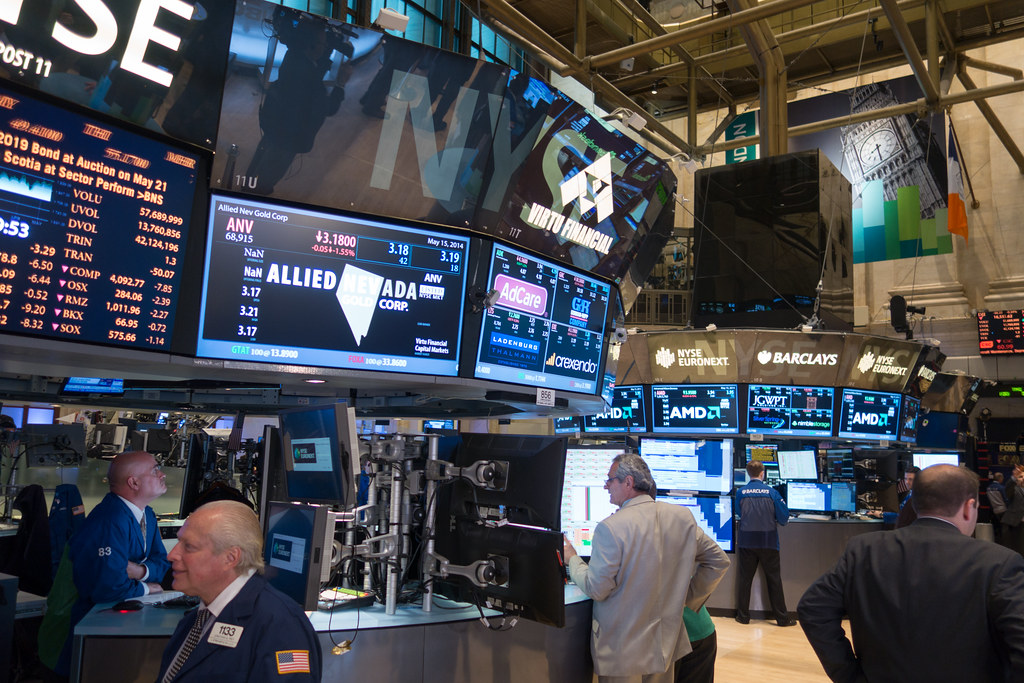
Wall Street retreated from record highs Thursday, October 30, as Federal Reserve Chair Jerome Powell cast doubt on additional rate cuts while massive AI spending by technology giants spooked investors worried that artificial intelligence investments may never generate adequate returns. The S&P 500 dipped 0.99% to finish the day at 6,822.34, while the Nasdaq Composite dropped 1.57% to close at 23,581.14 and the Dow Jones Industrial Average traded down 109.88 points or 0.23% to 47,522.12.
Megacap tech giants Alphabet, Meta and Microsoft each reported quarterly results after market close Wednesday, with Alphabet shares popping 2.5% on the back of strong results while shares of Meta and Microsoft tumbled more than 11% and roughly 3% respectively as investors grew worried about the increased spending outlooks for both companies. The divergent reactions demonstrate that Wall Street will punish even profitable technology giants if capital expenditure plans appear excessive relative to near-term revenue opportunities.
The Federal Reserve delivered a widely expected quarter-point rate cut Wednesday, lowering its target range to 3.75% to 4%, but Powell’s press conference comments suggested the central bank may pause its easing cycle in December. The Dow Jones Industrial Average declined 0.2% or 74.37 points to finish at 47,632 points after hitting a record high in the session before the rate cut announcement, while the S&P 500 fell 0.30 points to end at 6,890.59 points after recording a new all-time high in the previous session.
Powell’s hawkish pivot caught investors off guard who had been pricing in aggressive monetary accommodation through year-end. The Fed Chair’s emphasis on data-dependency and caution about declaring victory over inflation suggested that September’s cooling CPI report may not be sufficient to justify continued rate reductions. Conservative economists argue that the Federal Reserve should prioritize price stability over supporting asset prices, though equity investors naturally prefer accommodative policy regardless of inflation risks.
The rally was led by a jump in NVIDIA Corporation’s stock after the AI darling made history by becoming the first company to reach $5 trillion in market cap, with shares of NVIDIA rising 3%. The semiconductor giant’s historic milestone occurred just hours before Meta’s earnings revealed that AI infrastructure spending could reach levels that trouble even bull market enthusiasts, creating cognitive dissonance about whether artificial intelligence represents genuine productivity revolution or speculative excess.
President Donald Trump and Chinese President Xi Jinping concluded with the U.S. agreeing to cut fentanyl tariffs on China to 10% while Beijing delayed the latest curbs on rare earth exports by a year. Trump stated that rare earth issue has been settled, though China’s restrictions announced in early April remain in place. Louise Loo, head of Asia economics at Oxford Economics, said in a note Thursday that China’s leverage in rare earths and critical minerals processing will continue to surface episodically, effectively capping any escalation in bilateral tensions.
A selloff in several megacaps dragged down the S&P 500 following a $17 trillion surge from its April lows, with the US and China trade truce seen as mostly priced in. The market’s muted response to what Trump characterized as an amazing meeting with Xi demonstrates that investors had already bid up equities in anticipation of positive outcomes, leaving little room for upside surprises even when negotiations succeeded.
Equities triggered a Hindenburg Omen, a technical indicator that occurs when a bifurcated market loses momentum amid lackluster breadth. The ominous-sounding signal reflects deteriorating market internals despite headline indexes trading near all-time highs, suggesting that narrow leadership from technology mega-caps may be masking underlying weakness across broader market segments. Conservative technicians note that Hindenburg Omens have preceded major market declines historically, though false signals are common enough that the indicator should not be viewed as definitive timing tool.
Chipotle shares plunged about 15% in extended trading Wednesday, adding to concerns that consumer spending may be weakening as the government shutdown extends into its fourth week and economic uncertainty weighs on household confidence. The burrito chain’s disappointing results suggested that even premium fast-casual restaurants face traffic challenges when middle-class consumers tighten budgets.
Just five old economy stocks account for nearly all of the outperformance of the Dow Jones Industrial Average on Thursday relative to the underperformance of both the S&P 500 and Nasdaq Composite Index, with Goldman Sachs alone lifting the DJIA by about 140 points in mid-morning trading while Visa, Sherwin-Williams, JPMorgan and Caterpillar all drove the DJIA higher by about 40 points each. The divergence reflects the price-weighted Dow’s unusual construction that allows expensive stocks to disproportionately influence the index regardless of their actual market capitalization.
The three weakest stocks in the Dow Industrials held it back by some 200 points combined, with Microsoft alone chopping off more than 70 points from the DJIA. The selling pressure in Microsoft following its quarterly report demonstrates that even the world’s second-most-valuable company faces investor skepticism when capital expenditure guidance suggests management may be overspending on artificial intelligence infrastructure without clear path to monetization.
Wolfe Research said Thursday that potential U.S.-China trade stability in the wake of agreements made between President Donald Trump and Chinese President Xi Jinping could lead to gains for the market, with Tobin Marcus writing that this truce does not resolve fundamental issues in the U.S.-China relationship or reverse the long-term trend toward decoupling and confrontation, but a simple truce is good enough for markets. The assessment reflects pragmatic recognition that complete resolution of U.S.-China tensions remains impossible given fundamental differences between American and Chinese systems.
Marcus wrote that what markets need is stability on U.S.-China trade tensions, and we largely accept at face value that today’s agreement will stabilize the relationship for the next year. This modest expectation represents significant lowering of ambitions compared to Trump’s campaign rhetoric about forcing comprehensive Chinese concessions, though conservative trade analysts argue that tactical truces serve American interests better than endless confrontation that damages both economies.
Treasury yields rose and the dollar strengthened following Powell’s hawkish comments, creating headwinds for both equity valuations and corporate earnings as higher borrowing costs and stronger currency weigh on profitability. Bond investors who positioned for continued rate cuts through year-end found themselves caught wrong-footed by the Fed Chair’s caution, triggering sharp selloffs in longer-duration securities most sensitive to interest rate expectations.
Bitcoin and cryptocurrency markets declined alongside equities as the broader risk-off sentiment weighed on speculative assets. The digital asset’s inability to rally despite the Trump-Xi trade agreement demonstrates that cryptocurrency remains correlated with technology stocks rather than behaving as independent safe-haven alternative. Conservative investors who allocated to Bitcoin expecting it to hedge against geopolitical risks discovered that the digital asset provides little protection during equity market selloffs driven by monetary policy concerns.
Gold prices edged higher as safe-haven demand returned following the equity market decline, though gains remained modest compared to the precious metal’s recent volatility. The yellow metal’s resilience demonstrates that traditional safe havens retain appeal when stock markets retreat, particularly given concerns about excessive valuations and deteriorating technical conditions. Portfolio managers who reduced gold exposure following its early October crash may now regret failing to maintain adequate hedges against equity market corrections.
The question facing investors as October concludes is whether Thursday’s selloff represents healthy profit-taking following a powerful month-long rally or the beginning of more serious correction that could extend into November. The convergence of Federal Reserve hawkishness, technology spending concerns, and lackluster market breadth creates challenging environment where multiple bearish catalysts threaten to overwhelm the constructive setup from trade deal optimism and strong corporate earnings.
Meta’s 11% single-day plunge following its earnings report sends chilling message to other technology companies planning massive AI infrastructure investments. The social media giant’s guidance for continued elevated capital expenditures through 2026 spooked investors worried that building data centers and purchasing chips may consume cash without generating commensurate revenue growth. Conservative analysts note that many technology executives appear more focused on winning AI arms race than generating returns for shareholders.
Microsoft’s more modest decline reflects that its cloud business momentum partially offsets spending concerns, though the stock’s weakness demonstrates that even the most profitable technology companies face scrutiny when capital allocation decisions appear questionable. The Redmond giant’s guidance for 2025 capital expenditures between $91 billion and $93 billion represents staggering commitment to AI infrastructure that assumes demand will materialize as enterprises adopt machine learning across business processes.
The timing of Meta’s earnings disaster couldn’t be worse for technology bulls who had been arguing that recent valuation expansion was justified by AI-driven productivity improvements. The company’s stock collapse demonstrated that Wall Street will punish capital misallocation even when companies generate impressive revenue growth, calling into question whether other AI-focused technology giants trading at premium multiples can sustain current valuations if spending continues accelerating faster than returns.
As markets head into November, the combination of Federal Reserve uncertainty, technology spending concerns, deteriorating breadth, and ominous technical signals creates treacherous environment for momentum-chasing investors who bought equities near all-time highs. Conservative portfolio managers who maintained defensive positioning despite missing October’s rally may find their caution vindicated if the Hindenburg Omen proves prescient and broader correction materializes during what is typically favorable seasonal period for stocks.

Leave a comment