

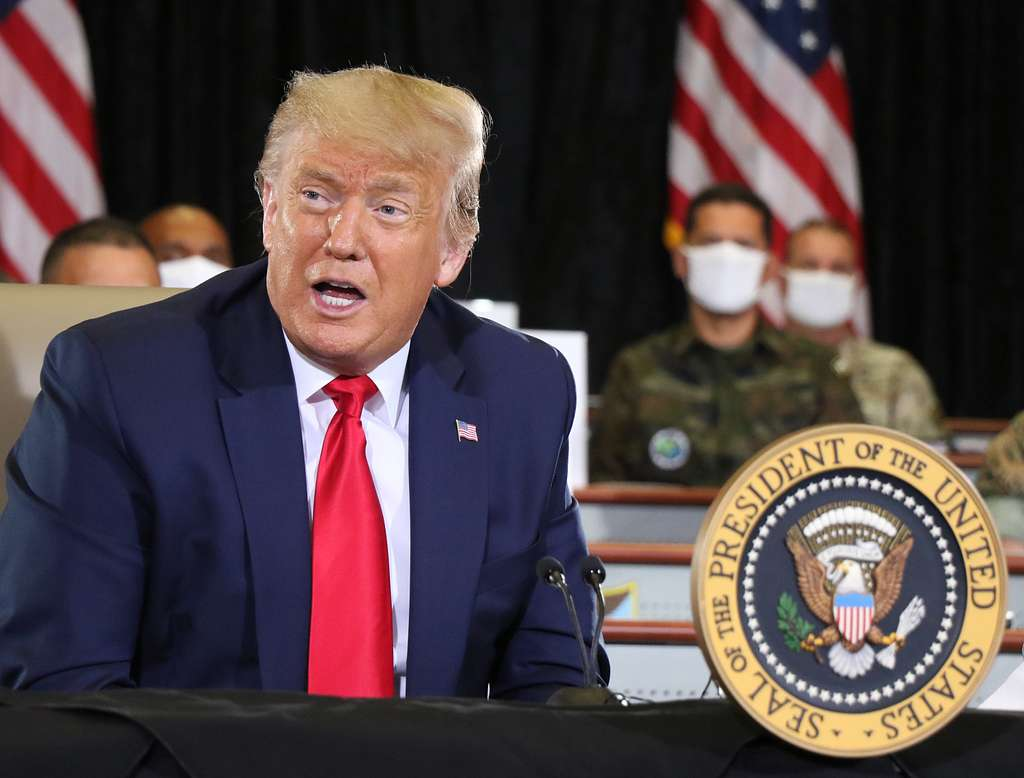
President Donald Trump called Thursday, November 20, 2025, for the execution of six Democratic lawmakers who released a statement urging military personnel to refuse illegal orders, escalating his authoritarian rhetoric to unprecedented levels that even some Republicans characterized as dangerous incitement to political violence. Trump called for the arrest of lawmakers who urged troops to disobey illegal orders that might be issued by the administration, calling it punishable by death.
Democratic leaders condemned what they described as death threats, while Speaker Mike Johnson said he would not have used the same words but criticized the lawmakers’ message. Johnson’s mild rebuke demonstrates that Republican leadership refuses to clearly repudiate Trump’s calls for executing political opponents, prioritizing party loyalty over constitutional norms that prohibit threatening members of Congress with death for exercising their First Amendment rights.
Rep. Chris Deluzio of Pennsylvania responded that it’s an outrageous call for political violence against me and my colleagues who are members of Congress elected sharing a basic and fundamental truth about our Constitution. Democratic Sen. Chris Murphy of Connecticut stated this is extraordinary, that the President of the United States is calling for members of the political opposition to be executed.
Murphy added that I know that we have just normalized the president’s endorsement and celebration of violence, but this is something fundamentally different, noting this puts all of our lives in jeopardy. The Connecticut senator’s comments reflect growing alarm among Democrats that Trump’s increasingly violent rhetoric creates permission structures for his supporters to act on the president’s suggestions.
Sen. Angela Alsobrooks of Maryland stated that the climate that has been created in our country by this administration is one that hurts everybody. The statement followed Trump’s Thursday morning Truth Social post demanding that the Democratic lawmakers face arrest and execution for what he characterized as sedition and treason.
Sens. Elissa Slotkin and Mark Kelly and Reps. Jason Crow, Chris Deluzio, Maggie Goodlander and Chrissy Houlahan urged others to unite and condemn the President’s calls for our murder and political violence. What’s most telling is that the President considers it punishable by death for us to restate the law, according to the statement.
Our servicemembers should know that we have their backs as they fulfill their oath to the Constitution and obligation to follow only lawful orders, with it being not only the right thing to do but also our duty. The lawmakers’ original statement had emphasized that military personnel possess both legal obligation and moral duty to refuse orders that violate constitutional protections or international law, a basic principle of military justice that Trump characterized as sedition.
Senator Slotkin said during a conference that I’m not going to shut up because Donald Trump is threatening me, with Slotkin saying she was accompanied by security to the NewDEAL’s 15th annual Leaders Conference in Washington. The heightened security measures reflect genuine concerns that Trump’s rhetoric could inspire violence against targeted lawmakers, particularly given the president’s history of supporters acting on his suggestions.
Conservative constitutional scholars privately expressed alarm at Trump’s execution demands, noting that threatening elected officials with death for political speech represents textbook authoritarian behavior incompatible with democratic governance. However, few Republicans were willing to criticize the president publicly, demonstrating how completely Trump has captured the GOP despite his repeated violations of basic constitutional norms.
The execution threats occurred as Washington’s political establishment gathered for former Vice President Dick Cheney’s funeral, providing stark contrast between traditional bipartisan respect for political opponents and Trump’s violent rhetoric. Past presidents and politicians of both parties gathered in Washington for former Vice President Dick Cheney’s funeral at the Washington National Cathedral, with tributes from his family, former President George W. Bush and others who worked closely with Cheney during his decades in politics.
Notably, President Donald Trump and Vice President JD Vance were not invited, reflecting the Cheney family’s complete break with Trump following the January 6 attack and Liz Cheney’s leadership role on the House committee investigating the Capitol assault. The funeral provided rare moment of Washington unity as Republicans and Democrats set aside partisan differences to honor Cheney’s service, though Trump’s absence highlighted how thoroughly he has destroyed traditional norms of political civility.
Former President Bush remembered his vice president as a true man of the West and said Cheney was an old breed of public servant, defined by their substance and character. Bush told the story of how he chose Cheney to be his running mate and the moment he realized the best choice for the vice president was the man sitting right in front of me.
The funeral’s guest list itself nodded to a time when Washington was not so polarized and politicians from both sides paid their respects when dignitaries passed away. The contrast between the ceremony’s bipartisan dignity and Trump’s simultaneous calls for executing Democratic lawmakers could not have been starker, illustrating the chasm between traditional Republican governance and the MAGA movement’s embrace of authoritarian tactics.
Trump signed legislation directing the Department of Justice to publicly release all its Jeffrey Epstein-related files, finally capitulating to political pressure after months of resistance. The Justice Department now has 30 days to comply with the law, though some lawmakers worry the administration may try to hinder the process by slowing the release or redacting information.
Attorney General Pam Bondi stated that the Department of Justice will continue to follow the law amid questions over the timing and scope of the documents’ release. Senators from both parties warned that the DOJ must comply with the legislation’s requirements and release unredacted files within the statutory deadline rather than employing bureaucratic delays or excessive redactions to protect powerful figures.
President Donald Trump’s approval rating has fallen to 38%, the lowest level of his second term, according to the November Reuters/Ipsos Core Political survey. The survey finds the economy is the most important problem facing the country, up six points from last month and knocking political extremism out of the top concern, with three in five saying the country is headed off on the wrong track.
The approval collapse demonstrates that Trump’s victory in forcing Democratic capitulation on the government shutdown did not translate into improved public standing. His calls for executing political opponents likely contributed to the declining numbers, as even some Republicans expressed private discomfort with rhetoric that violates basic democratic norms regardless of policy disagreements.
The question now facing Washington is whether Trump’s escalating authoritarian rhetoric represents dangerous escalation that could inspire violence against lawmakers or merely inflammatory language that his supporters understand as hyperbole. Democrats argue that the president’s pattern of violent suggestions followed by supporter actions demonstrates clear causal relationship requiring congressional censure or stronger measures.
However, Republicans dismiss these concerns as overblown reactions to Trump’s characteristic rhetorical style, arguing that Democrats themselves have used inflammatory language about Trump and his supporters. Speaker Johnson’s refusal to clearly condemn the execution threats demonstrates that GOP leadership views maintaining party unity as more important than defending constitutional norms prohibiting threats against elected officials.
As the Epstein files release approaches and Trump’s approval ratings plummet to new lows, the convergence of his authoritarian rhetoric with mounting evidence of dysfunction creates politically perilous environment heading into the 2026 midterm campaigns. Democrats plan to feature Trump’s execution threats prominently in campaign advertisements portraying Republicans as threats to democracy, though the effectiveness of such messaging remains uncertain given voter concerns about economic issues outweighing abstract constitutional principles in polling.

Leave a comment