
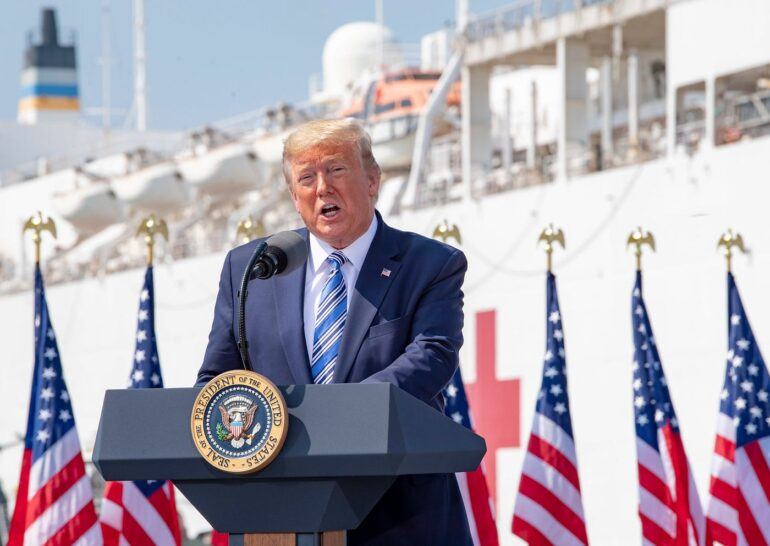
The Supreme Court agreed, Friday, to decide whether President Donald Trump possesses constitutional authority to eliminate birthright citizenship for children born in the United States to illegal immigrants or temporary visitors, setting up a landmark ruling that could fundamentally reshape American immigration policy and the meaning of the 14th Amendment’s citizenship clause. The justices will hear Trump’s appeal of a lower-court ruling that struck down the citizenship restrictions, with oral arguments scheduled for spring and a definitive ruling expected by early summer.
The birthright citizenship order, which Trump signed January 20 on the first day of his second term, represents one of the most ambitious and legally questionable actions of his presidency. The executive order declares that children born to parents who are in the United States illegally or temporarily are not American citizens, directly challenging the plain text of the 14th Amendment which states that “all persons born or naturalized in the United States, and subject to the jurisdiction thereof, are citizens of the United States.”
Conservative constitutional scholars remain divided about whether Trump’s order can survive judicial scrutiny given the explicit language of the 14th Amendment. The clause was adopted after the Civil War specifically to overturn the Supreme Court’s Dred Scott decision and ensure that all persons born on American soil regardless of their parents’ status would be recognized as citizens. The historical context makes clear that the Framers intended birthright citizenship to apply broadly rather than being subject to restrictions based on parental legal status.
However, Trump administration lawyers argue that the phrase “subject to the jurisdiction thereof” creates an exception for children whose parents owe allegiance to foreign governments or lack legal authorization to remain in the United States. Solicitor General D. John Sauer contends that children born to illegal immigrants or temporary visitors do not meet the jurisdictional requirement because their parents are not fully subject to American legal authority in the same manner as citizens or lawful permanent residents.
The American Civil Liberties Union, representing challengers to the executive order, argues that no president can unilaterally change the 14th Amendment’s fundamental promise of citizenship through executive action. The organization notes that the Supreme Court’s 1898 ruling in United States v. Wong Kim Ark established that children born in America to foreign parents are citizens regardless of whether the parents could themselves become citizens, directly addressing the jurisdictional question that Trump’s lawyers now seek to relitigate.
The case under Supreme Court review comes from New Hampshire, where lower courts issued preliminary injunctions blocking implementation of the citizenship restrictions anywhere in the country. Multiple federal district judges and appeals courts have ruled against the administration, finding that the executive order violates both the Constitution and federal statutes governing citizenship determinations. The nationwide injunctions have prevented Trump from implementing his policy while litigation proceeds, though he has repeatedly attacked judges who ruled against him as activist Obama and Biden appointees.
The Supreme Court’s decision to grant review on an expedited basis demonstrates the justices recognize the need for quick resolution of questions affecting hundreds of thousands of births annually. The accelerated schedule means oral arguments will occur during the spring 2026 term with a ruling expected before the Court’s summer recess, providing clarity about citizenship status for children born during the 11 months since Trump signed the executive order.
Conservative supporters of Trump’s position argue that birthright citizenship has created perverse incentives for illegal immigration, with pregnant women crossing the border specifically to give birth on American soil and secure citizenship for their children. They contend that the Framers never intended the 14th Amendment to reward illegal conduct by conferring citizenship on children whose parents violated immigration laws, and that modern application of birthright citizenship represents judicial overreach rather than faithful interpretation of constitutional text.
However, critics note that eliminating birthright citizenship would create a permanent underclass of stateless individuals born in America but lacking citizenship in any country. The children affected by Trump’s order would face deportation to nations they have never visited, where they lack legal status, family connections, or ability to speak the local language. Creating such a population contradicts American values and practical governance considerations regardless of whether narrow constitutional interpretation might theoretically permit such results.
The Supreme Court announcement came hours after FIFA president Gianni Infantino awarded Trump a controversial peace prize during the 2026 World Cup draw ceremony at the Kennedy Center in Washington. The recognition represents an unusual break from tradition for the soccer-focused organization, whose president has become a close ally of Trump despite the administration’s immigration policies affecting numerous FIFA member nations.
FIFA gives its new peace prize to President Donald Trump in an unprecedented move that shocked the international sports community. The ceremony happened Friday during the 2026 World Cup draw, coming after Trump had openly campaigned for the Nobel Peace Prize which was instead awarded to Venezuelan opposition leader Maria Corina Machado. FIFA president Gianni Infantino had publicly stated he thought Trump should have won the Nobel this year for his efforts to broker a ceasefire in Gaza.
The FIFA peace prize award drew immediate criticism from human rights organizations who noted Trump’s immigration crackdowns, boat strike operations killing drug trafficking suspects without trial, and threats to execute Democratic lawmakers create jarring contrast with traditional peace prize recipients. Progressive activists characterized the award as corrupt attempt by Infantino to curry favor with the American president ahead of the 2026 World Cup which the United States will co-host with Mexico and Canada.
However, Trump supporters celebrated both the FIFA recognition and Supreme Court’s agreement to hear the birthright citizenship case as vindication of the president’s agenda. Conservative commentators argue that Trump deserves credit for Middle East peace efforts including the Israel-Hamas ceasefire and his willingness to challenge failed immigration policies that previous administrations lacked courage to reform despite obvious problems.
The convergence of the Supreme Court case with the FIFA peace prize demonstrates Trump’s determination to reshape both domestic policy and international perceptions of American leadership regardless of institutional resistance or traditional norms. The president’s transactional approach treats constitutional constraints as obstacles to overcome rather than fixed limits on executive authority, creating ongoing confrontations with courts, Congress, and civil society organizations defending traditional American values.
As the Supreme Court prepares to hear arguments about birthright citizenship, the question facing the justices is whether the 14th Amendment’s citizenship clause means what it says or whether creative interpretation can accommodate Trump’s policy preferences. Conservative institutionalists worry that ruling for the administration would establish dangerous precedent allowing future presidents to rewrite constitutional provisions through executive orders rather than pursuing the amendment process the Founders designed for changing fundamental law.
The case will test whether the Court’s conservative majority believes that originalist constitutional interpretation requires adherence to the 14th Amendment’s plain text or whether other considerations including immigration policy concerns can justify departing from clear constitutional language. The ruling will affect millions of children born in the United States over coming decades, making it one of the most consequential decisions the Court will issue during Trump’s second term with implications extending far beyond the current political moment.
