
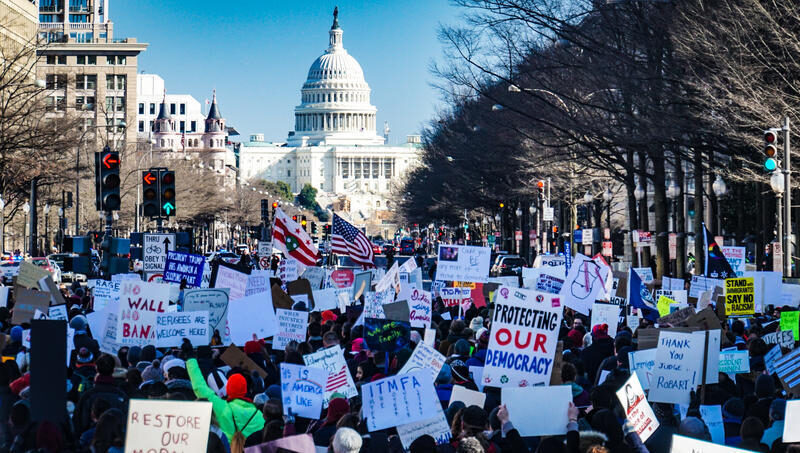
Millions of demonstrators flooded streets across all 50 states Saturday in what organizers called an unprecedented national mobilization against President Trump’s policies, with furloughed federal workers joining progressive activists in the largest coordinated protest movement since the administration’s return to power. The nationwide rallies came on the 18th day of the government shutdown as Democrats continued blocking Republican efforts to reopen the government without accepting their healthcare subsidy demands.
The demonstrations organized by the Indivisible Project featured crowds stretching for blocks in major cities while smaller gatherings materialized in rural towns traditionally supportive of Trump. In New York City, protesters packed Times Square before marching toward Lower Manhattan, while Washington witnessed current and former federal employees rallying on Pennsylvania Avenue demanding calmer political rhetoric and an end to the budget standoff leaving them without paychecks.
One furloughed federal employee protesting in Washington told reporters she is losing sleep over worries about her job and paying bills. The employee had been furloughed within the first few hours of the shutdown that began October 1st, joining hundreds of thousands of government workers sent home or forced to work without pay as Congress remains deadlocked over funding legislation.
Local news coverage showed Revolutionary War reenactors in Jefferson City, Missouri, musical performers in Gainesville, Florida, and demonstrators distributing free copies of the Constitution inside boxes labeled “ICE melter kits” in Charleston, West Virginia. American flags appeared at protests across the country as participants emphasized patriotic themes rather than the anti-American rhetoric that characterized some progressive demonstrations during Trump’s first term.
In Marietta, Georgia, large crowds gathered along roadways carrying signs with messages including “Honk if you’re NOT in the Epstein files” and references to immigration enforcement policies. Atlanta protesters rallied to honor the city’s civil rights legacy, with organizers describing Saturday’s demonstration as a peaceful but urgent call to protect democracy and reject hate.
Conservative commentators noted the irony of millions mobilizing to protest democratically elected leadership while characterizing their movement as defending democracy. Republican strategists argued the protests demonstrated progressive refusal to accept electoral defeat rather than genuine concern about constitutional governance, pointing out that Trump won the 2024 election with a clear mandate to implement the policies now being challenged in the streets.
Participants in smaller cities and towns documented their events via social media, with protesters gathering along Main Streets, at major intersections, in municipal parks and on highway overpasses. In Charlottesville, Virginia, one attendee said the crowd looked twice as big as the first local “No Kings” gathering in June. In Swansea, Massachusetts, protesters described the turnout as the largest by far compared to previous demonstrations at the same intersection.
Author Lynn Ames told reporters after attending a protest in ruby-red Hendersonville, North Carolina, that if you love this country, saving democracy is a priority no matter where you live, including in small-town America. She described witnessing the demonstration as a beautiful thing and being part of it as more beautiful still, reflecting the emotional intensity driving the protest movement.
The Department of Homeland Security issued warnings Thursday about the potential for certain events to become violent according to an intelligence report sent to law enforcement agencies, though officials indicated they were not aware of any specific and credible threats nor did they identify any planned protests by name. The security assessment highlighted concerns that left-wing protest movements have increasingly embraced confrontational tactics that risk escalating into violence.
Transportation Secretary Sean Duffy addressed air traffic controllers who have called out sick during the shutdown, creating flight delays at major airports. Duffy said air traffic controllers have to come to work and show up because that’s their job, stating he will make necessary cuts at the Department of Transportation and at NASA as the government shutdown continues. The Secretary blamed Democrats in Congress for delays in controllers’ pay but promised they would receive it depending on when Democrats agree to reopen the government.
Duffy warned that two thousand to three thousand more air traffic controllers are needed across the understaffed system and that even a few calling out sick sends a ricochet through the air space that leads to delays. His statement that the administration will slow travelers down if necessary to maintain safety standards demonstrates Trump’s determination not to cave to pressure tactics from federal employees attempting to force policy concessions through work disruptions.
Some airports refused to display a video message from Homeland Security Secretary Kristi Noem explaining Democratic responsibility for the shutdown. A spokesperson for the Port of Portland, which operates Portland International Airport, Hillsboro Airport and Troutdale Airport, confirmed a request came from the Transportation Security Administration to display the video message but stated they did not consent to playing the video in its current form, believing the Hatch Act clearly prohibits use of public assets for political purposes and messaging.
Republicans dismissed Hatch Act concerns as selective enforcement, noting that government officials routinely communicate with the public about policy disputes without triggering violations. The Portland airport’s refusal to display Noem’s message reflects the deep partisan divisions in blue states where local officials actively resist Trump administration communications even when federal law appears to permit such messaging.
House Speaker Mike Johnson warned Monday that the nation is barreling toward one of the longest shutdowns in American history unless Democrats drop their partisan demands and pass a clean no-strings-attached budget to reopen the government and pay federal workers. Johnson invoked former President Barack Obama’s 2013 statement refusing to pay political ransom in exchange for reopening the government, drawing a direct parallel to the current Republican position.
Johnson quoted Obama saying he wouldn’t pay political ransom in exchange for reopening the government, then stated that what Obama demanded then is exactly what Republicans are saying now, that they will not allow the American people to be taken hostage over partisan demands. This comparison highlights what Republicans view as fundamental hypocrisy from Democrats who previously opposed leveraging government shutdowns for policy concessions but now refuse to reopen the government without Affordable Care Act subsidy extensions.
The Speaker characterized Democratic tactics during a Fox News interview, stating they’re trying their best to distract the American people from the simple fact that they’ve chosen a partisan fight so they can prove to their Marxist rising base in the Democrat Party that they’re willing to fight Trump and Republicans. Johnson’s comments reflected growing frustration among congressional Republicans who believe Democrats are prioritizing political theater over the immediate needs of federal workers and military families going without paychecks.
While House Minority Leader Hakeem Jeffries argued that his caucus wants to have a broader bipartisan conversation about fixing America’s broken healthcare system, Johnson fired back that Democrats are eating up the clock in the month of October to conduct such talks as the shutdown drags on. Republicans maintain that healthcare policy negotiations should occur separately from emergency government funding measures, arguing that basic operations should not be held hostage to unrelated policy disputes.
Johnson said he spoke on the phone recently with Representative Marjorie Taylor Greene, who has been vocal about her concerns that Republicans could shoulder the blame for their constituents’ skyrocketing health insurance premiums. The Speaker told the Georgia congresswoman that Republicans have been working around the clock on addressing the issue and offered to include her in those conversations with relevant committees, demonstrating the political complexity facing GOP leadership as they navigate between principles of fiscal responsibility and constituent service demands.
The convergence of massive nationwide protests with the 18th day of the shutdown created maximum pressure on both parties to reach agreement, though neither showed signs of backing down from core demands. Democrats calculated that public demonstrations combined with federal worker hardship would eventually force Republicans to negotiate on healthcare subsidies. Republicans countered that voters would ultimately hold Democrats accountable for blocking clean government funding while pursuing policy demands that could be addressed through separate legislation.
The question facing both parties is whether political considerations or constituent hardship will prove more persuasive in breaking the deadlock that has paralyzed Washington and left essential government services across the nation in limbo. As millions took to the streets Saturday expressing frustration with Trump’s agenda, the president and congressional Republicans showed no inclination to compromise on their fundamental position that Democrats must vote to reopen the government before negotiations on healthcare or other contested policies can proceed.

Leave a comment